


WE DO DATA #MANAGEMENT

We’re sharing everything you need to know about data management: what it is, why it matters, and how it creates the foundation for every insight, decision, and business outcome. From data acquisition and storage to quality, lifecycle, and intelligence; data management is the engine that keeps organisations running.

WHAT IS DATA MANAGEMENT?

Data management is the practice of acquiring, storing, organising, maintaining, and delivering data across an organisation’s entire environment, from the moment raw data enters your systems to the moment it becomes trusted information in the hands of decision-makers.

It encompasses the people, processes, systems, and standards required to treat data as the critical business asset that it is. Without it, data is noise. With it, data becomes your most powerful competitive advantage.

THE DATA LIFECYCLE

01

ACQUISITION

Scanning, discovering, and extracting data from internal and external sources via ETL/ELT processes.

02

INGESTION & STORAGE

Landing data into data lakes, operational data stores (ODS), or data warehouses for persistence.

03

CURATION & QUALITY

Merging,
de-duping, validating values, and enriching data so it becomes trusted information.

04

INTEGRATION & MASTERING

Combining datasets into master data and storing in warehouses or data marts for consistency.

05

DELIVERY & ANALYTICS

Presenting qualified, trusted information to BI, analytics teams, and operational systems.

06

ARCHIVE & SUNSET

Managing retention, archiving for compliance, and decommissioning data at end-of-life.

INSIGHTS

Data Management
Ben Botha

Where Data Becomes an Asset: The KID Group Approach

Problem We often say “data is an asset,” but in reality, most organisations don’t experience it that way. Instead, data feels messy, inconsistent, duplicated, and unreliable. Decisions get delayed because no one fully trusts the numbers, teams work in silos with conflicting definitions, and simple questions turn into drawn-out investigations.


Read More »

How data management transforms your business

Trusted, Qualified Data

Data that has been cleansed, validated, integrated, and verified against reference source, so every decision is made on information you can rely on.

Operational Efficiency

Data management eliminates redundant processes, duplicate systems, and wasted resources, enabling organisations to do more with less and at speed.

Deeper Business Insight

From descriptive reporting to predictive and prescriptive analytics, well-managed data powers intelligence that tells you what happened, where you’re going, and what to do next.

Security & Compliance

Data management enforces security controls, privacy standards, and regulatory compliance (like GDPR) throughout the full lifecycle of every data entity.

Scalable Architecture

From structured relational databases to unstructured big data lakes, sound data architecture and metadata management ensure your environment can grow without breaking.

AI & ML Readiness

Machine learning and AI can only perform where data is clean, connected, and governed. Data management creates the foundation that makes intelligent automation possible.

THE DISCIPLINES OF DATA MANAGEMENT

From descriptive (what
happened) to predictive
(where are we going) to
prescriptive (what should
we do) — analytics turns
trusted data into forward
looking intelligence.

The front-end
presentation layer —
dashboards, reports, and
visual outputs that deliver
qualified, trusted
information to decision-
makers across the
business.

Profiles, cleanses, de-
duplicates, validates, and
monitors data
continuously — so every
piece of information
delivered to the business
is accurate, complete, and
trusted.

Manages unstructured
data — documents,
records, digital content,
social media — stored
alongside structured
datasets in your data lake
environment.

Protecting data from
unauthorised access, loss,
or misuse.

Managing core business
data and standardised
values to keep information
consistent and accurate
across systems.


Warning: Undefined array key "hotspot_offset_y" in /var/www/vhosts/kidgroup.co.za/httpdocs/wp-content/plugins/elementor-pro/modules/hotspot/widgets/hotspot.php on line 1060

Warning: Trying to access array offset on value of type null in /var/www/vhosts/kidgroup.co.za/httpdocs/wp-content/plugins/elementor-pro/modules/hotspot/widgets/hotspot.php on line 1060

Platforms for persisting
and serving data at scale
— data lakes for all data
types, warehouses for
structured and mastered
information, data marts for
targeted delivery.

ETL/ELT processes that
extract data from internal
and external sources,
transform it, and land it
into your central
environment for use.

Builds and maintains the
pipelines, processes, and
systems that keep
operational data flowing
correctly through the
organisation.

Manages databases,
storage platforms, and the
day-to-day operational
data environment —
ensuring data is reliably
available when it’s
needed.

From descriptive (what
happened) to predictive
(where are we going) to
prescriptive (what should
we do) — analytics turns
trusted data into forward-
looking intelligence.

Designs the structure of
your entire data
environment, aligning data
assets with business
needs and ensuring
systems are built to scale.

Managing data definitions,
ownership, and the full
journey of data from
creation to archiving or
deletion.

Data is the business glue. You can’t do anything without it, and data management is what makes it reliable.​

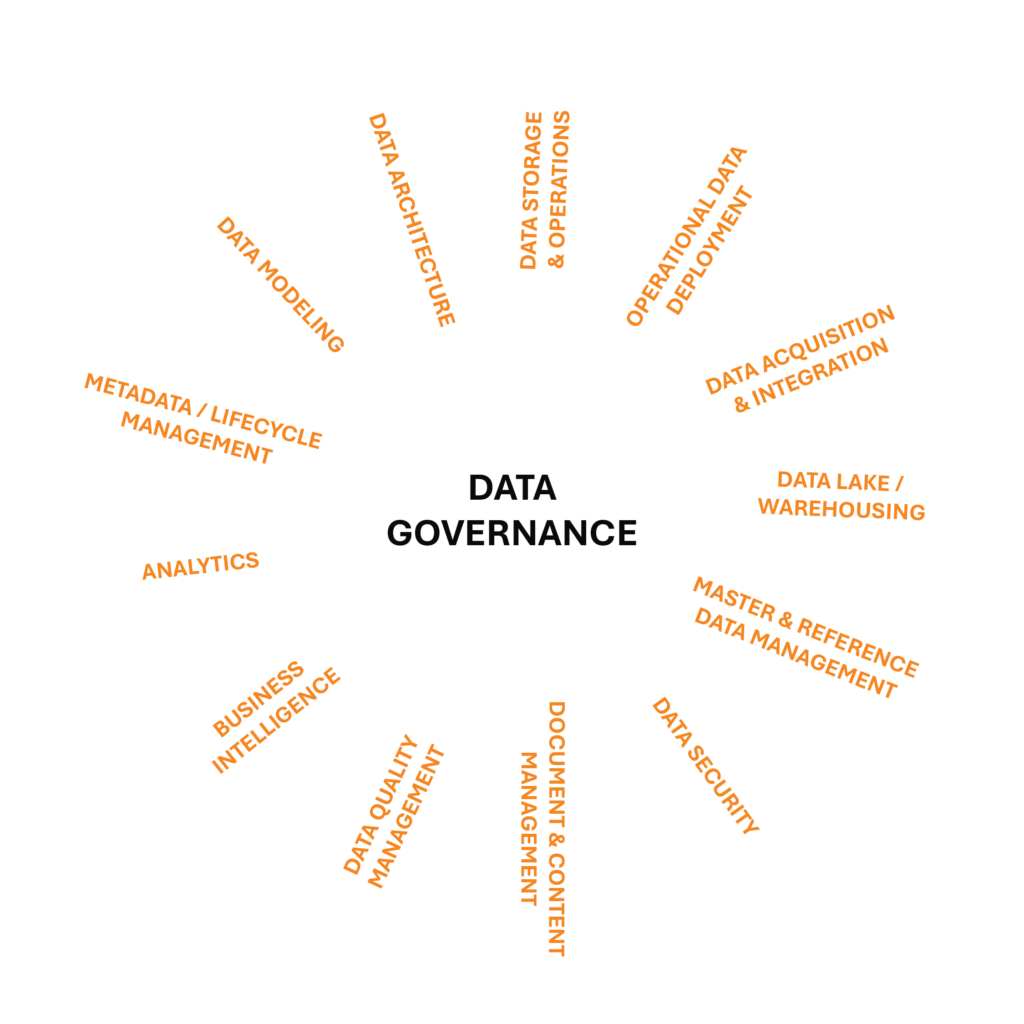
DATA MANAGEMENT VS. DATA GOVERNANCE

They work together — but they are not the same thing. Here’s how to think about the relationship.

DATA MANAGEMENT

  • Defines, acquires, stores, processes, and delivers data
  • Operates the disciplines and competencies
  • Implements the systems, tools, and pipelines
  • Executes the security measures and mechanisms
  • Enables analytics and reporting
  • Manages the full data lifecycle end-to-end

DATA GOVERNANCE

  • Sets the policies, principles, standards, and guidelines
  • Asks: why are you doing this? Against which compliance?
  • Establishes data ownership and accountability
  • Monitors and controls what happens across all disciplines
  • Ensures data management is done correctly and efficiently
  • Has overarching control of every data discipline

POWERED BY AI & MACHINE LEARNING

AI and machine learning wrap around the entire data management environment. Where there is data, machines can learn, automating processes, detecting anomalies, generating models, and surfacing insights at a speed no human team can match alone.

But with that capability comes responsibility. AI must be controlled, ethical, and governed, otherwise automation without oversight creates compounding risk across every discipline it touches.

The progression from descriptive intelligence to autonomous action is already here.

01 DESCRIPTIVE ANALYTICS
 
What happened? Understanding past performance through reporting and dashboards.
 
02 PREDICTIVE ANALYTICS
 
Where are we going? Extrapolating trends into forecasts and future scenarios.
 
03 PRESCRIPTIVE ANALYTICS
 
What should we do? Recommending actions to optimize outcomes.
 
04 GENERATIVE & AGENTIC AI
 
I’ll generate it. I’ll do it automatically. AI that creates and acts, with governance guardrails.

START WITH THE FUNDAMENTALS.

We guide organisations to where they need to start,  not just where they want to start. The most common mistake is jumping to analytics or AI without the foundational data management disciplines in place. We ask the bigger questions, scope the full picture, and help you deploy solutions in the most resource-efficient way possible.

That’s the KID Group difference.

ENGAGE WITH US